A few years ago, I found myself stuck. On the outside, life looked fine — I had a good job, I was an executive leader of companies with all the perks. But inside, I felt restless and empty. My days blurred together from one board meeting to the next; from one report to the next. I woke up with neck pains and low energy, and I couldn’t shake the thought that I was living someone else’s life.
Then I attended a shareholders’ meeting where I learned about gross negligence by my colleagues. I quit and instantly felt the relief. But the honeymoon soon faded. How would I pay the bills? I had to get my act together.
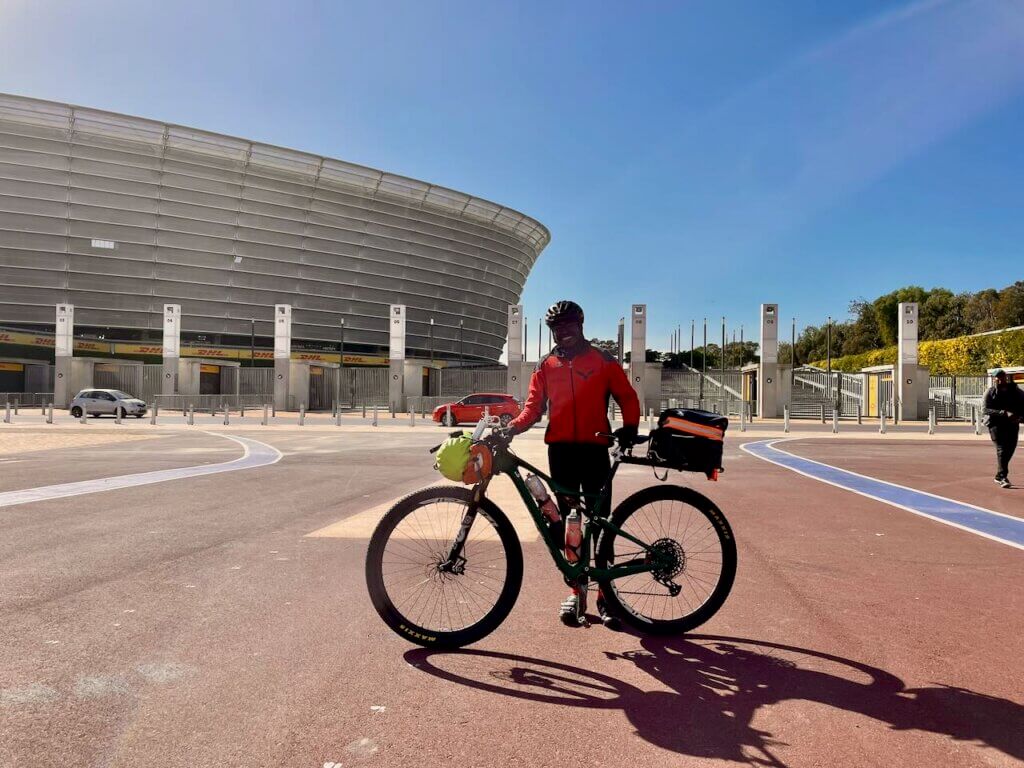
But before that, I wanted to achieve a dream I had held for 7 years — cycling from Musina, at the very top of South Africa, all the way to Cape Town at the bottom. Over 3,000 km on two wheels, no support car, self-sufficient; nothing but determination and a deep need to rediscover myself.
While training and preparing for the journey, a friend suggested that I add a cause. So, I partnered with Barefoot No More, the same non-profit that delivered over 20,000 pairs of school shoes for Mr Beast’s campaign in Cape Town. If they could raise 20,000 school shoes, surely I could raise money for 10,000 pairs, I thought to myself. So, my mission was clear: Cycling from Musina to Cape Town for 10,000 school shoes.
The road was brutal. Long days in the sun, endless hills, aching muscles, and moments of doubt were a constant feature. On day seven, while crossing the Drakensberg Mountains, from Barberton to Badplaas, I ran out of water and food while still climbing a treacherous mountain pass. There was no signal, and my body had long given up. Positive self-talk gave way to self-doubt. I stopped the bike, sat at the edge of the road, high in the mountains, and sobbed like a baby. I soon realised that no help would come—I had to keep going.
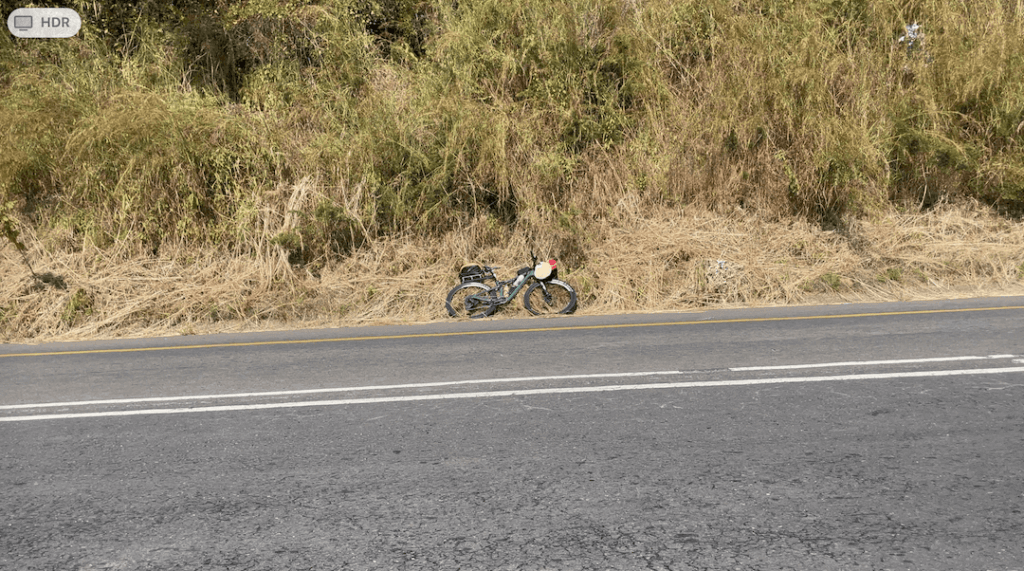
Somehow, I summoned the will to keep pedalling. Two hours later, I saw a glorious sign, indicating that it would be downhill from there. I stopped and took a photo of the sign, relieved that the suffering had ended. After a small decent, I saw a truck that had passed me some thirty minutes earlier, struggling up another steep face of the mountain. In sheer disbelief, I broke down and cried again. Once again, however, I caught myself in the middle of a sob, wondering if crying would change anything. So, I gathered myself and kept going for another few hours. It was not until six hours later that I hit the threshold, and it was time to descend into Badplaas, where I found that the hotel had no food.
By the third week, I was fit, strong and prepared. I had cycled over 2,000 km on in all weather and had entered the magnificent Western Cape. However, I was nowhere near reaching my goal of raising money for 10,000 school shoes. In fact, I had barely raised funds for 1,000 pairs. But something strange was happening in the background.
My wife, whom I spoke to every day on the phone, started receiving an influx of phone calls from radio stations and local newspapers. People were spreading the word on social media. As soon as media outlets caught on to my mission, tens of thousands in donations poured in, some of which were from the largest companies in South Africa. It struck me, then, that the goals of cycling and raising money were entirely different — one required grit, and the other required buy-in.
By the time I rolled into Cape Town, completely transformed as a person, I reflected on my journey and decided to start skybookings.com. The journey was quite similar to cycling in that I started with hardly any resources as a solo-founder. Today, skybookings has touched over 16,000 customers in just two years, owing to a firm commitment to the lessons learned from cycling from Musina to Cape Town for school shoes. With the benefit of hindsight, I have distilled some of those lessons into core principles that I share with whoever cares to listen. In this post, I want to focus specifically on setting and achieving goals — because there’s a deep insight that I discovered, that I have never heard anybody else talk about.
Before we proceed, I added a workbook that you can download at a small fee at the end if you want to go deeper and show appreciation. I wrote and designed the workbook myself — in fact, it draws on the notes and journal entries I made during the cycling journey. So, it is based on a lived experience and reflection, not AI. This workbook is for those who are ready to take their transformation journeys seriously. However, that is not to take away from what insights I have in store for you in this article. This article will be a perfect resource for starting your journey the right way to avoid losing steam and quitting mid-way.
One more thing—you will need a blank sheet of paper and a pen. I have prepared an exercise to help you assimilate some of these insights.
The Two Types of Goals
Most of us beat ourselves up for not achieving our goals. We think, “If I just worked harder, or if I got another degree… if I had enough money…” or some other reason. But here’s the truth. The reason some goals feel different from others is that not all goals are the same. And if you don’t know the difference, you will remain frustrated, working hard with no signs of progress. There are two types of goals, and I have dubbed them (a) Individual and (b) social goals. Let’s unpack them:
A: Individual Goals
If you recall, my cycling journey had two goals. The first was getting to Cape Town, and the second was raising money. Getting to Cape Town was the Individual Goal. If I stopped pedalling, the goal stopped. If I kept going, the goal became more achievable. Progress was completely tied to my personal effort and ability to keep going, hence I call it an individual goal.
In the same way, weight loss, shooting the next episode of your podcast, finishing a book, running a marathon, studying for an exam, or practising a musical instrument — these are all individual goals. They all depend on discipline, effort, and consistency.
B: Social Goals
Fundraising was the second type of goal. To succeed, I had to persuade other people to believe in the mission, to trust me, and take action. That’s the key difference: social goals require buy-in from others, whereas individual goals only need you to keep going.
You might recall that the closer I got to Cape Town, the more journalists and funders wanted to get involved. I only realised this after the journey, when reviewing my journal. The question is why? As it turns out, the answer is simple. All persuasion happens on a foundation of trust. The closer I cycled to Cape Town, the more people trusted me to complete the mission and fulfil the promise of delivering the school shoes. So, more and more people donated. The more people saw others donate (social proof), the more donations poured in.
In other words — and this is the critical idea —the more you achieve your individual goals, the more people trust you to deliver on social goals. Think about a personal trainer. The more they spend time in the gym, building their own bodies, the more people will trust them to help on their journeys. This was a breakthrough insight for me because I suddenly realised that I no longer had to persuade people to do anything. I only had to focus on achieving my individual goals publicly (and I will get back to “publicly” this soon) and let the progress speak for itself.
This became my mantra going into skybookings. I had no social media following (I still don’t). However, as I continued building the software with one customer, they told the next, and before I knew it, we had crossed the R1 million revenue threshold and served thousands of customers.
Publicising Progress
Having said this, there are still some design decisions you can make to get your individual goals to spread. I posted the journey every day in a WhatsApp group and on my Instagram and Twitter pages. People shared my videos, and donors, sponsors, and journalists eventually got the news and started spreading it. In other words, you can also design your mission to spread organically — a subject I unpack in a lot more detail in the workbook I mentioned earlier. Critically, this is not about social media virality; it’s about designing your mission to intentionally spread by itself and creating the conditions for your community to grow by itself.
Summary and Action Steps
Most people fail because they treat every goal like an individual one. They double down on effort when buy-in is required. Or they try to get buy-in on tasks that do not require other people’s approval. But once you distinguish between individual and social goals, and use the right tools for each, you start to see real progress quickly. In addition, your confidence in achieving your goals goes up significantly.
Here’s a quick exercise:
- Take a blank sheet of paper and write all your goals.
- When you’re done, label them with an S or an I (for social and individual).
- Then flip the page and rewrite the goals, focusing only on Individual goals.
- Once you have a list of individual goals, narrow them down into 1 goal that matters. For me, it was cycling from Musina to Cape Town — everything flowed from there. This is your mission A. Make sure it is clear and achievable.
- Then write all your social goals, and likewise narrow them down to 1 social goal. For me, it was raising money for R10,000 school shoes. This is your mission B.
- Then think about how to share progress with insiders and outsiders. For me, this was opening a WhatsApp group and posting three videos every day: morning, afternoon, and evening updates. I also posted progress on social media. My posts were never about soliciting money (i.e. I never asked people to donate); they were always about progress on both goals: the individual and the social, with a bias towards the individual goal because they created the trust to activate the social goal — remember we spoke about that earlier?
- Then start and keep going
Believe it or not, step 7 is the hardest, and most people get stuck because they overthink the journey or life gets in the way. I had thought about ending this article here, but maybe this next section will be helpful if you struggle with finishing what you started.
Bonus 1: Staying motivated
You’ve probably experienced it before. At the beginning of a new goal, you feel unstoppable. You buy the gym clothes, download the apps, make the lists, buy new food, and design your new routine. You tell everyone who cares to listen, and for a while, you’re on fire.
And then… life happens.
Deadlines pile up. The kids get sick. Your energy dips. You get sidetracked, and suddenly, the goal you were so excited about slips away, and you eventually don’t even want to talk about it. This is where most people quit — not because the goal wasn’t right, but because motivation faded.
The Truth About Motivation
By day 19, when cycling from Harding to Kokstad, I just didn’t want to do it anymore. My body was tired, and there was nothing I could do to shake off the demotivation and negative self-talk. My hands were cramping, and my knees were constantly painful. My body was no longer recovering. So, I called Neil and Johan, a 60-something-year-old who had cycled from Durban to Cape Town and a 50-something-year-old who had cycled from Johannesburg to Durban, both of whom had joined my WhatsApp group.
Neil asked where I was. For a moment, I thought he would fetch me. When I told him, he said, “Are you crazy!? You are cycling the toughest stretch in the country, climbing at an extraordinary rate with a 50kg bike—you have to slow down!” I dragged myself to the next town and dropped like a sack of potatoes and slept for 12 hours.
It dawned on me the next day that I was so focused on the big mission that I thought I needed to do something big every day. However, my mentors on the journey share a different insight. The brain cannot tell the difference between a big and a small win. All it registers is the goal and whether it was achieved. If the goal is achieved, the brain releases endorphins, dopamine and other feel-good hormones, encouraging you to do it again. However, if it is not achieved, it releases stress hormones and painkillers, which protect but make you feel heavy.
Big wins are made up of small wins
The key is to shrink your goal down to the smallest possible action you can take and achieve today — something so easy it feels almost laughable.
An outsider might think you are lazy or not “pushing yourself” enough. But that is precisely the point. The point is to nurture a progress-oriented mental state—a positive voice in your head. Then, over time, as confidence, motivation, and momentum grow, you can scale up the size of the goals. But even then, be careful not to overextend yourself.
My training to cycle from Musina to Cape Town began with walking every day because I have asthma, so I could not run. After a while, I started running, but also slowly, until the momentum grew. Then I gained the confidence to cycle long distances, initially by giving up driving and commuting by bicycle to meetings.
Likewise, after crashing on day 17, I reduced my distances each day from 100-150km to about 60km-100km per day. I suddenly had time to gaze at the mountains, feel my body and enjoy the journey. I can truly say that my journey began in the Eastern Cape, when I was relaxed and feeling good.
- For weight loss, a micro-win could be: drink one glass of water before every meal.
- For writing a book: write one paragraph per day.
- For reducing your debts: transfer R50 into a savings account whenever you have it.
The point isn’t the size of the action. The point is to keep moving forward, no matter how small the step. Small wins create momentum, and momentum beats motivation.
Let’s Recap (TLDR)
There are two types of goals: Individual and Social. Individual goals require effort and discipline. Achieving them depends entirely on you. Social goals require buy-in — more effort does not result in more achievement. However, individual goals can (and often do) influence social goals. Therefore, turn your goals into a worthy mission. Design your mission to people along with you on the journey towards achieving the social mission.
It is tempting to want to work hard towards a big mission. However, the real risk is burning out and getting injured on the way — including emotionally. The solution is to adopt a progress-orientated mentality, where each step is celebrated, no matter how small it is. This is the key to enjoying the journey and achieving massive goals.
But here’s the next trap — and it’s just as dangerous:
👉 Even if you know the difference between individual vs social goals (Part 1)…
👉 Even if you’ve mastered micro-wins and momentum (Part 2)…
Most people still struggle because they do not have a comprehensive guide, a map, a North Star. They watch this YouTube Video, ask AI (withou realising that it will not answer unasked questions), and end up with a patch work of advice.
If you want a comprehensive guide based on lived experiences, if you want to learn how to achieve your goals and transform into a new and better version of yourself, then you might want to join the hundreds of achievers who have downloaded the booklet for R249 R100 (once off)
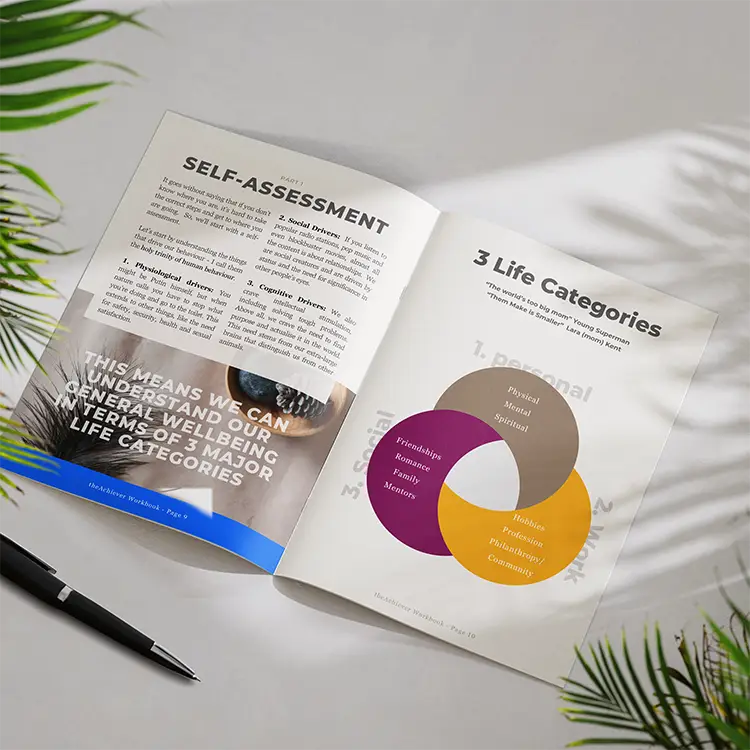
The workbooks come in an easy-to-print PDF that you can download to start immediately. Here’s what you will find inside
16 helpful tools inside—at a glance
- A self-assessment tool that shows you, in 15 minutes, where your life is thriving… and where it’s silently falling apart.
- How to collapse dozens of scattered ambitions into just three life goals that truly matter.
- A simple exercise that forces you to choose your one mission—the goal that will pull all the others forward.
- Why most people chase outcomes instead of journeys… and the shift that makes goals feel lighter (yet more achievable).
- The hidden difference between individual goals (effort alone) and social goals (persuasion required) — and how treating them the same guarantees failure.
- Six persuasion triggers (verified by psychologists) that build community and trust.
- Why your brain can’t tell the difference between a small win and a big win — and how to exploit this quirk to stay motivated.
- A daily checklist method that multiplies tomorrow’s success by planting “seeds” today.
- The counterintuitive wisdom of going slower to go further — learned during a 3,000 km cycle.
- Why mountains, setbacks, and struggles are your best teachers (if you know how to listen to them).
- How to celebrate “downhills” without losing it all and having to start from scratch.
- The surprising lesson that “conditions change”… and why adjusting milestones (not missions) is the secret to resilience.
- The character-building exercise that turns your dream into an identity (and makes procrastination almost impossible).
- A 7-day challenge that converts theory into practice — and momentum into habit.
- The exact questions to ask three friends so they become part of your accountability network.
- A system for reviewing and resetting goals that keeps you on track long after the excitement fades
Free Bonus: Reinvent Yourself
Upon reflection — now three years after my cycling journey — I’ve had many people asking me to write about my journey or to create a documentary. This has prompted deep reflection on how I have changed as a person, and how the journey has unfolded from leaving my corporate job, pursuing a dream I long held, and starting a business I believe makes a difference.
My reflections point to many questions that people who still feel stuck might have. So, I wrote a booklet that documents the journey to re-inventing oneself, hoping that it will be helpful to those on a similar path. The REINVENT YOURSELF booklet is included for free alongside the workbook.
I hope this article and the resources offered have been helpful. If I can help in any way, let me know.
With Warmth
Vusi.
P.S. My goal now is to acquire a PhD in philosophy in the next five years and buy a farm where I will focus on doing academic work. This was unimaginable just a few years ago. And so it is for the goals you might have now — if you work on them, soon you might find yourself doing work that was previously off the charts. With a guide, the journey may be easier and faster.
I wish you all the best.