Tag: business philosophy

Recent thoughts and ideas about business, life and things we are often too shy to talk about

Business is not about money

About 20 years ago, I stood in a parking lot with a friend who has since become a billionaire and one of the most successful entrepreneurs in the country. On that day, he gave me advice that infuriated me, which I now espouse.

To give you context, I was 21 years old, and he was my client. I was building software to manage the installation of 5,000 tracking units in government vehicles. He used my reports to bill his clients. But there was a problem. Many tracking units installed were not reporting to the server — they were faulty. Meanwhile, he was billing based on installations. After a while, his client — the government — queried the discrepancy, stopped paying and launched an investigation.

The reason we met that day was that I had not been paid for two months. Apart from boycotting some of the work, I had also become disruptive, protesting non-payment. When I demanded my money, he said, “Business is not about money.” As you can imagine, this made me furious! He was living in Sandton, driving a fancy car, and occupying shiny offices, while I was driving my dad’s car, living at home, and barely eking out a living. How dare he say business is not about money?

Over the years, I firmly held the view that business is about nothing but money. But lately, my sentiments are changing. As I write, I think business is indeed not about money, even though it is essential. This is how I reconcile the idea:

A good analogy is the body. It has many organs, including the brain, the heart, the lungs… and so on. Blood courses through all the organs, making it an essential fluid for their proper functioning. However, we do not say that the body is about blood. Instead, we study the blood to ascertain the body’s condition.

Likewise, business has many parts: people, marketing, sales, products, strategy… and so on. Similarly, none of these parts can function without money flowing through them somehow. A strategy is meaningless without resources; you cannot build a team without paying them; products do not exist without some investment. Therefore, money and how it moves is essential for understanding business health. This is an entrepreneur’s first job — cash flow management.

Important as money is, however, we should not mistakenly elevate its status to business itself. Business is about sustainably providing value where it is needed most. The market signals this need with a willingness to pay. In other words, every cent that comes into a business should signal value captured by the market, and every cent that leaves the business should signal value created for the market.

The view that business is about money overlooks this essential rhythm — value creation and value capture. When value is created but not captured, the business runs out of money. If value is captured without creating it, it’s a scam.

So, I hold the view that business is not about money. However, watching how money flows in and out of a business — and its organs — is critical for understanding its health and capacity.

Until next week.
Vusi.

P.S you might have missed something I said. “Business is about sustainably providing value where it is needed most.” Sustainability is about the profit motive, which I will explore in next week’s post.

If you are not subscribed, use the link below to join. And please favour me by sharing this article with a friend you think might find it helpful.
On the seriousness of business

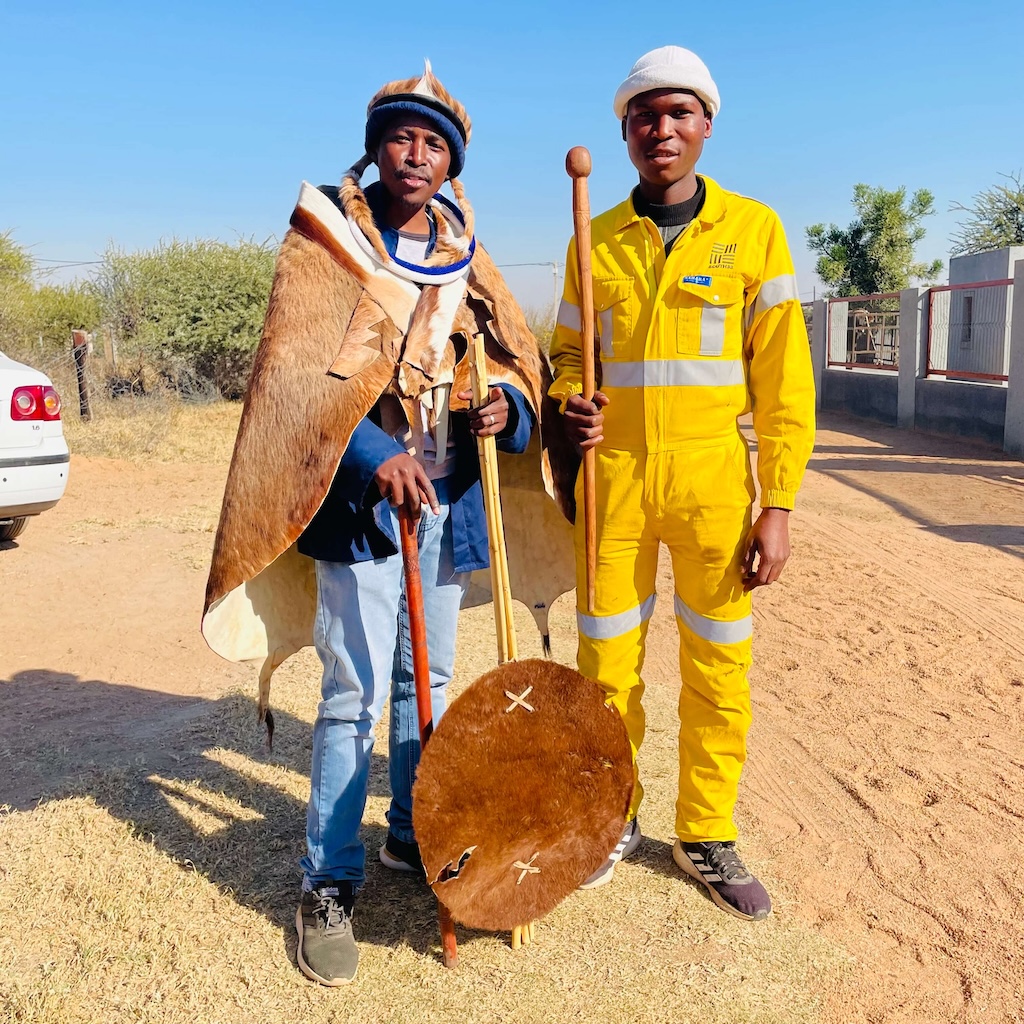
I have spent the past 2-3 months mainly at my ancestral home in Mpumalanga, observing my son’s rite of passage into adulthood. Part of the pleasure of this period is sitting with elders, from whom we hear stories of old that preserve principles and an ancient way of life.

Left: Me, Right: Calvin (my nephew)

I learned that upon marriage, newlyweds were given a patch of land by the local chief. Then the bride’s brothers helped to build a small house, usually a single room, for their sister and brother-in-law. This was their final farewell and an inadvertent way of keeping their brother-in-law uncomfortable in a house he had not built. The husband would then plan and build a larger house over a longer period of time, assisted by his friends and brothers.

While building their homestead, vegetables would slowly grow in their backyard, and eventually, they would establish their lives. Through various rituals and favours, livestock would be introduced, and the young household would thrive and grow in stature. Over time, children would grow: if girls, they would attract cattle; if boys, they would receive cattle from their father as a blessing to marry and establish their own homes.

—Bear with me; this is still an essay on the seriousness of business.

Today, life is different. Those who dare to marry must first buy cattle because they have become a scarce asset. There are many reasons households no longer have cattle. Many families were displaced from their lands; others were forced to use cattle to pay for their children’s education. So, the problem is that the price of cattle has gone up while the rules for taking a wife, i.e. 6–12 cows in some families, remain unchanged. This excludes other costs, like traditional attire, food, and logistics, which makes marrying an extremely expensive exercise.

The result is that men no longer marry as young as they used to. Marriage was a sacred step that marked yet another stage of life; now it is gate-kept with a price tag. Without the means to pay the price, one stagnates. And since unmarried men cannot perform certain traditional duties, they feel disempowered, take to alcohol or devolve into monsters.

—What does this have to do with business?

I share this story and history to demonstrate the impact of financialisation. Before money made the world go round, people were guaranteed passage through various milestones that signalled maturity, conferred rights and responsibilities, and bestowed status. However, in a financialised economy, one’s “capabilities” and “identity” depend on money and a misplaced notion of meritocracy. I challenge meritocracy in relation to money because effort does not necessarily translate to money. Many people work hard, only to dig deeper financial graves the harder they work — in part due to debt traps and inflation. Moreover, the economic context could derail a fine business in months. Suppose you run an e-commerce business and then a war breaks out in Iran, and suddenly fuel prices make the cost of doing business untenable. So, money is an unstable foundation upon which livelihoods and identity are built.

Like it or not, however, business is one of the primary organs through which money circulates. I hope you can see where I am going with this. Even as an employee, without understanding how businesses work and their role in a financialised economy, one is completely exposed. Worse, if you run a business, other people’s identities, dignity and livelihoods depend almost entirely on you — a responsibility carried only by kings, who discharged it from a rich base of social, cultural, and even military infrastructure, in the old days. Now, livelihoods depend on lonesome, ill-equipped founders who build with whatever influence they can radiate. This is the weight of business.

For this reason, it strikes me as odd that one would venture into business without taking it seriously and studying it, whether formally or informally. It is often assumed that business is intuitive and that it can be figured out. However, this is not true. Failing to distinguish between a strategy and a plan, for instance, can have serious consequences. Another example is distinguishing management from leadership, or sales from marketing. Simply put, people who follow ill-prepared business leaders risk destroying their lives; they are flying in a plane where the pilot is fiddling in the cockpit to see what works. As an ill-prepared leader, you risk destroying people’s lives.

For this reason, every business owner, founder, and entrepreneur must have a library of business books, at least. Their hobby must be to study business; their friends must be fellow entrepreneurs; and instead of visiting the bar, they should attend workshops. At some point, they should even forget about listening to music and listen to business podcasts. This does not imply that they will master business. Mastery is ultimately acquired through practice. But it will create an index page in the mind, populated with problems and solutions. Then, upon encountering a problem, one would be better equipped to ask the right questions from which, hopefully, correct answers are knowable.

In closing, we live in a highly financialised economy. Our lives and sense of identity depend on money and its institutions, whether we like it or not. Therefore, immersing oneself in business — how it works, why it works the way it does (even if one disagrees), and the problems that often emerge because of business — is easily the greatest investment to make.

So, happy investing.
—Vusi

P.S. These five books formed a significant part of my business identity and approach.

Search 19 years of thoughts

Your cart is currently empty.

Return to shop

Stop hustling, Start building

Learn the business fundamentals for building a genuine business that creates financial freedom and gives your family an unfair advantage.