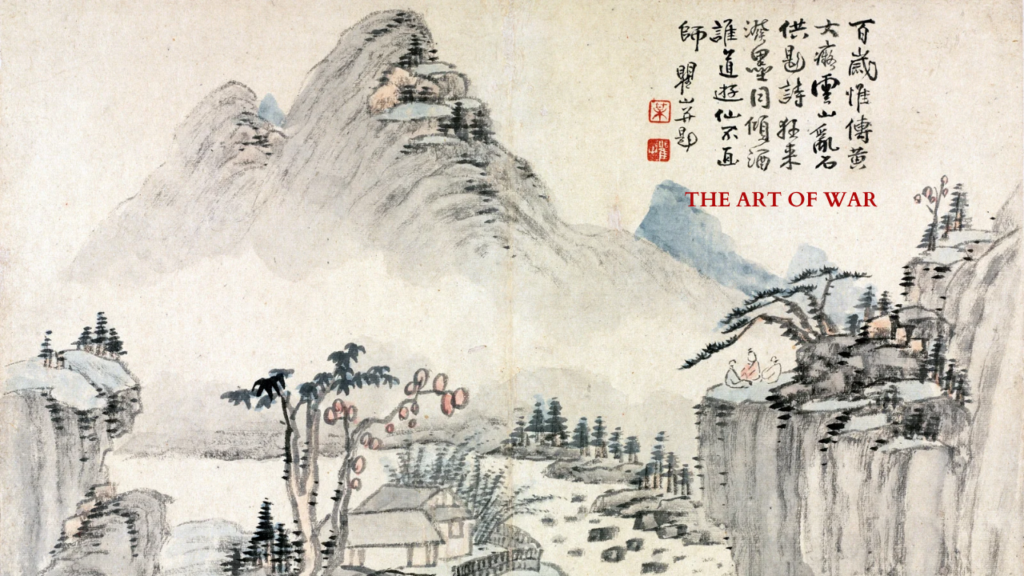
“War is a matter of life and death,” wrote Sun Tzu. In today’s financialised societies, business is a matter of economic life and death. It is war without bullets, as some have said; death without blood. Therefore, studying one of the oldest texts on war, strategy and victory is easily the greatest investment anyone could make, especially in a fast-paced world where fewer and fewer things seem to make sense.
Contrary to popular belief, some historians believe Sun Tzu was a scholar more than he was a warlord. Some debate whether he even existed, let alone commanded an army. Nevertheless, the prevailing historical account is that when war broke out in his home state, called Wu, he went to the King to offer advice on how to defend it. Unconvinced, the King asked for a demonstration by challenging him to convert 180 apparently spoiled concubines into a fierce fighting force. The challenge was meant to ridicule and mock this nobody. But Sun Tzu accepted the challenge on the condition that once in command, the King could not interfere. Sure enough, he gathered the concubines and divided them into two groups, appointing the King’s favourites as captains.
By the way, that is one of the principles in the Art of War. “The control of a large force is the same as that of a few men: it is merely a question of dividing their numbers.” Chapter 5 (1)
Sun Tzu gave his first instructions to the concubines by demonstrating some movements. Then he ordered that they repeat the movements when the drum sounded. The ladies chuckled and giggled. Accordingly, as set out in Chapter 10, “when the commander’s orders are not clear and distinct… the result is utter disorganisation.” Sun Tzu repeated himself, this time clearly outlining the instructions and then giving the orders again. But again, the ladies giggled away.
“Therefore, soldiers must be treated in the first instance with humanity and brought under control by means of iron discipline.” Chapter 9 (43)
Sun Tzu then gave orders to have the captains’ heads cut off – the King’s favourite concubines. They knelt before the court, and Sun Tzu raised his sword. But having seen enough, the king ordered him to stop. Sun Tzu then reminded him that when in charge, not even the King could interfere. With a swipe of the blade, there was a thud on the floor. He reissued instructions, but this time the concubines followed him without hesitation.
This is one of the few stories known about Sun Tzu, pregnant with a powerful lesson. However, like other contents in The Art of War, the story is grossly misinterpreted. From a Western perspective, where we are attuned to Machiavellian, Nietzschean, and Foucauldian notion of power, we may reflect on this story as Sun Tzu’s ruthless establishment of control. But even deeper than that, the story emphasises the first sentence in The Art of War. “War is a grave affair of the state; it is a matter of life and death.” In other words, war has serious consequences on the livelihoods of scores of people, and everybody involved must take it seriously. It is from taking it utterly seriously that lives are saved, which, as I will argue later, is more in keeping with the thesis that The Art of War is a treatise on peace-making rather than war.
The Times in Which Sun Tzu Lived
The year is 780 BCE. Under the auspices of King You, the twelfth of the Zhou dynasty, the Kingdom has enjoyed a long reign of 266 years. Then a major earthquake shakes the Kingdom, reducing large cities to rubble. People regard this as a bad omen, signalling the last days of the dynasty. In a practical sense, the omen is correct because seismic events destabilise ways of life, economies and government, which creates opportunities for change.
A year later, a concubine enters the King’s palace. Unlike the others, she hardly smiles or tries to appease the King. This draws the King’s attention, who then wants to tame her. He brings her to his court, and soon enough, she bears him a son. But still, this she remains solemn and formal. Undeterred, the King deposes the Queen and her son, the crown prince. He installs the concubine as the new Queen, and she becomes known as Queen Bao Si – the dynasty destroying beauty who never smiled.
The royal shuffle sends shockwaves throughout the Kingdom. But fearing the King, people remain hushed, and speak only in dark alleys and hallways. Still unable to impress his new Queen, the King devises yet another plan. For the next few weeks, he orders his court to light warning signals. His noblemen rush to the capital, sometimes from hundreds of kilometres, believing their King to be under attack. But it is a prank and a way of amusing the Queen.
The king continues meddling with military codes and other state instruments in her favour. In no time, his noblemen stop taking him seriously. Meanwhile, his ex-father-in-law, the Marquess of Shen, aggrieved by his daughter’s unfair deposition, makes designs against him to avenge the shame that the King has brought to his family. Now that the King’s court no longer takes warning signals seriously, the Marquess of Shen forms an alliance with the nomads and leads a scathing attack on the capital. He slays the King and his new son, and captures the new Queen. Nobody knows what becomes of her.
The Marquess of Shen garners the sympathies of the other noblemen, whose respect has also been undermined by the now-dead King. They agree to install his deposed grandson as the new King, who becomes known as King Ping of Zhou. But now that the capital lies in ruins, they make plans to move the young King and his court to the eastern side of the dynasty. As the omens had predicted, this marks the end of the Western Zhou dynasty and begins a new epoch dubbed The Spring and Autumn Period. But there is a problem.
In the east, the King has no authority or support. Even as he relocates to his new capital, he relies on distant vassals and noblemen to provide food and protection from the nomads. The King is also young and inexperienced, and is supported by his nephew, the Duke of Zhou, who assumes regency. As the Duke gains more power and prominence, he raises eyebrows amongst the royal family, who increasingly believe the regent will take power for himself. Hence, the family schemes in the shadows of the royal court and organises a rebellion to take the Duke out, but fails.
To avoid more rebellions and maintain the authority of the Zhou Kingdom, he introduces a political system called Fengjian. In this system, the King gives land and powers to his noblemen, essentially allowing them to run their states autonomously. Then, they subdivide the land even further and give it to people according to a prescribed class system. Indeed, this decentralisation of power quells the rebellions. But over the years, with increased autonomy over their land, the noblemen come to regard their King as a figurehead. Without an overarching umbrella of authority, the kingdom splinters into more than 150 principalities, all vying for power and independence. Over the next 400 years, the land degenerates into chaos as larger states invade smaller ones.
Four powerful states emerge. Unable to stop them, the Zhou court recognises them as fully independent, no longer accountable to the King. Then, in 334 BCE, a member of the royal family, the Duke of Wei, gives up the pretences and proclaims himself King of the state of Wei. Sure enough, the other strongmen follow suit and take up arms in defence of their Kingdoms. This marks the end of the Zhou Dynasty.
The Philosophy Underpinning The Art of War
Given the protracted conflicts and wars, thinkers and philosophers of the day studied human nature and war. Their mission was to quell the constant violence and encourage people to live in harmony with one another. This gave rise to many schools of thought and philosophers, all vying for recognition. In a sense, intellectual war ran parallel to the violent conflicts of the time. Eventually, two schools rose to prominence, now known as Confucianism and Taoism [pronounced DOWISM].
Kung Fu Tzu, later anglicised to Confucius, wrote that, “by nature people are close, by habituation they are miles apart.” Thus, he theorised that habituating people with rules and rituals was critical for bringing and keeping them together. For instance, he thought a child who reveres their parents and treats their older siblings piously would never revolt against the state. However, rules alone do not hold. So, he came up with rituals to inculcate the rules.
On the other hand, Taoist thinkers looked to nature. They inferred that nature was always in harmony and that the harmony arose from constant change. When it was hot, it would soon be cold. When we saw beauty, it was because we knew ugliness. In their thinking, therefore, we suffer when we refuse to change and adapt. For this reason, they thought water was the exemplar of how we ought to live. Famously, Lao Tzu, the author of one of the most famous Taoist books, wrote, “Be like water, for water nurtures all things and goes to places where man is loath to go. Water is soft and yielding, yet it penetrates and shatters mountains.” I could add that even the finest sword, when left in water long enough, rusts and loses its edge, yet water gives life.
Sun Tzu emerges from the Taoist tradition. We know this because in chapter six, he said, “Water shapes its course according to the nature of the ground over which it flows; the soldier works out his victory in relation to the situation they are facing. Therefore, just as water retains no constant shape, so in warfare, there are no constant conditions.” This might seem strange because Taoists promote harmony, and here we have Sun Tzu advising on war. The Art of War, however, reconciles with Taoism on many fronts, including the idea that the greatest warriors win without fighting. This alludes to achieving win-win situations, in which all parties get what they want without engaging in violent conflict. Even when violence is inevitable, Sun Tzu prescribes attacking by stratagem in chapter three, where he prefers attacking plans first; if that fails, dismantling allies; if that fails, attacking soldiers; and if that fails, laying siege as the final solution. Sun Tzu also cautions against protracted war for the hardships it causes to people and the cost to the state. All of the above allude to his adherence to the Taoist telos of harmony, but true to being like water, violence is not out of the question.
The reader will therefore draw greater dividends from studying the Tao te Ching alongside Sun Tzu’s Art of War since the latter is an expression of the former.
How to Read the Art of War
Nearly 2500 years have elapsed since the Tao te Ching proclaimed that “the name that can be named is not the true name.” This is the fundamental principle of a philosophy that emerged during the Warring States Period, upon which Sun Tzu’s Art of War is based. What is changing? How is it changing, and what will happen once it has changed?
Consider, for instance, that the original title of The Art of War itself is “Master Sun’s Military Methods”, not “The Art of War.” The latter emerged when French and English scholars started translating the work around 1772. Calling it “The Art of War” was a marketing ploy.
One could dismiss this as marketing mischief. However, the reader’s intentionality going into The Art of War, as opposed to Master Sun’s Military Methods, is different. The former has the sparkle of instinct, insofar as instinct is colloquially otherworldly. In this regard, it stimulates broad appeal, even among people who would never fashion themselves as warlords. The latter, on the other hand, is dull and crude and suggests an insider’s manual — hardly appealing to the everyman. Therefore, the reader of the Art of War is markedly different from the reader of Master Sun’s Military Methods.
My position is that it is significantly more important to read The Art of War as an insider’s handbook than as an art. My reasons require a further examination of what art connotes in our times. Today, we loosely throw in The Art of… when describing a complex discipline or something that requires a high level of skill infused with some mystery about how it is done. “The art of…” is a kind of magic wand. Think about the claim that “chess is an art.” It creates the impression that chess grandmasters are magicians in some respect.
I agree that they are magicians. However, magic to the practitioner is different from magic to the onlooker. To the onlooker, magic is a black box; it is input and output without revealing the method. A magician puts on a show (input) and makes it appear as though a man is cut in half (output) while misdirecting the onlookers, that is to say, while concealing the method. Likewise, to the onlooker, grandmasters do inexplicable things; the method is concealed. Hence, we regard them as magicians.
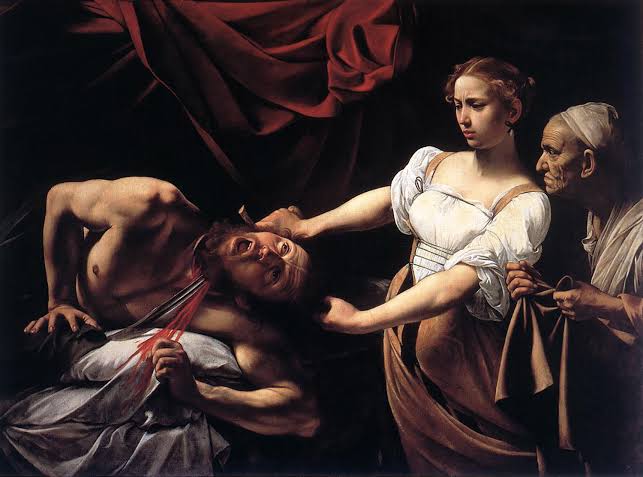
However, examining the practitioner’s perspective quickly reveals their method, which undermines the sense of magic. To demonstrate this, consider Carravagio, one of the most remarkable painters in history, who lived in the late 1500s and died in 1610. He is famous for the lighting technique called chiaroscuro, which dramatises his subjects. To the onlooker, one marvels at how he reproduced the creases on clothes and the anguish on his subjects. Historians tell us that he placed his models in a dark room and allowed a sliver of light to cast shadows on them, which he reproduced on canvas — hardly magical.
The student of The Art of War should therefore avoid reading the book as art insofar as it connotes magic. They should, instead, read it as a handbook of methods, developed through years of observation, by one of the finest scholars in history.
Structure and coherence
The Art of War is notorious for changing topics and themes in the middle of a chapter. Take the first chapter, for instance, which has three themes. The first is that “War is a matter of life and death”. It stressed the seriousness of war. The second theme discusses the five aspects of warfare that a practitioner could use to predict victory. The third theme is about deception — a proposition grossly misunderstood when read without understanding Taoist philosophy.
Recall, however, that it was written on bamboo strips. I imagine that each strip contained a compressed idea, like a tweet, and these were chained together to form what we call chapters. However, it is more accurate to consider it a collection of ideas, rather than chapters in the sense we would regard them today. This is likely what makes it hard to read from start to finish. I would even say reading it that way is pointless.
It is also worth considering the attitudes towards written texts during their time. The Taoist philosopher and Sun Tzu’s contemporary, Chuang Tzu, wrote: ”A fish trap is meant to catch fish. Once the fish are caught, the fish trap is forgotten. A rabbit snare is made to catch rabbits. Once rabbits are caught, the snare is forgotten. Words are meant to convey ideas. Once ideas are understood, words are forgotten.” Whereas in the Western tradition, the written word is the final authority, I surmise from Chuang Tzu that texts were functional tools meant to convey ideas. Understanding the idea was the ultimate goal, regardless of how the understanding was attained.
It is likely, therefore, that Sun Tzu and his contemporaries were not trying to write timeless bestsellers as we are apt to do these days. They made collections of ideas that were likely accompanied by oral, practical or other methods of transmission. In other words, the written text was part of a broader educational complex. As it were, a method of transition amongst many. Therefore, the modern reader will benefit more from adopting the Art of War as a companion.
The Art of War Itself
The Art of War has three major components: the first is in chapter one, a framework for understanding war — the five pillars, as I call them. The second component is in chapter four, the method for developing a strategy. Finally, the rest of the book either explains or adds more detail to the framework and the method. In the sections below, I will extract and explicate the framework and the method, and then share some key principles that Sun Tzu provides.
A Note to the reader: Here’s a free copy of The Art of War.
The Five Pillars of Strategy
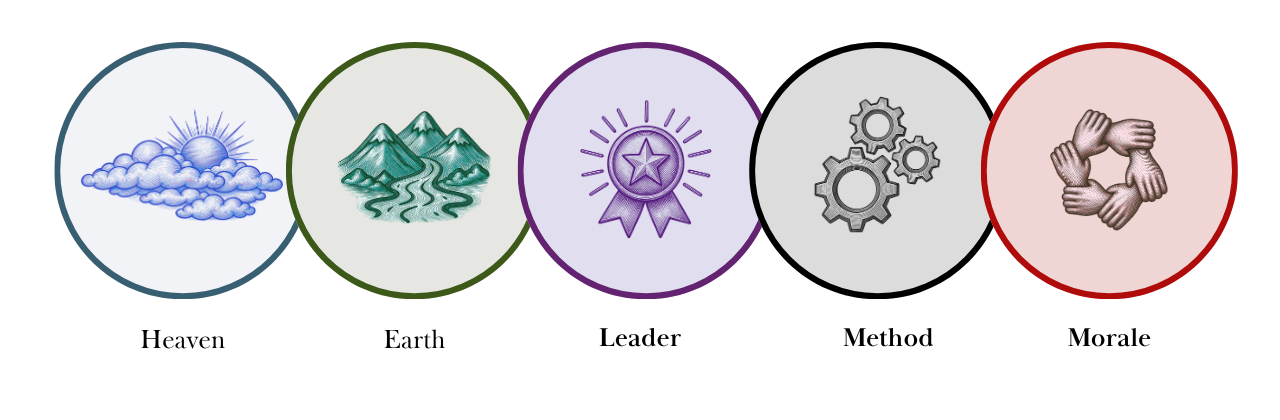
Heaven (Tian/天) encompasses the intangible, cyclical forces beyond human control — night and day, cold and heat, the seasons, weather, and timing more broadly. Sun Tzu is pointing toward an awareness of natural rhythms and conditions that shape when and how a campaign should be conducted. A commander who understands Heaven knows not to march troops into a brutal winter unprepared, or to attack when climate and season favor the enemy. It’s a call to read the broader environmental and temporal context rather than fighting against it.
Earth (Di/地) deals with the physical, spatial dimension of warfare: distances near and far, terrain that is dangerous or secure, open ground versus narrow passes, and whether the land favors life or invites death. This factor is about tactical geography — knowing the battlefield itself, understanding how terrain constrains or enables movement, supply, and defense. A general who has mastered Earth uses the land as a tool, choosing ground that magnifies his strengths and exposes the enemy’s weaknesses.
The Leader (Jiang/將), often translated as “the Commander,” refers to the qualities required of the person in charge: wisdom, sincerity, benevolence, courage, and strictness. Sun Tzu treats leadership as a composite of intellectual and moral virtues — a good commander must be shrewd enough to plan, trustworthy enough to be followed, humane enough to care for his troops, brave enough to act decisively, and disciplined enough to enforce order. The quality of this one individual has an outsized effect on everything else, since strategy and method are only as good as the person executing them.
Method and Discipline (Fa/法) covers the organizational architecture of the army — the structuring of ranks and units, the gradations of rank among officers, the maintenance of supply routes, and the control of military expenditure. This is the least glamorous but arguably most operational of the five factors: it’s about systems, logistics, and administration. An army can have moral purpose, favorable timing, good terrain, and a capable leader, but without sound organization and disciplined management of resources, none of that translates into effective action on the ground.
The Moral Law (Tao/道) refers to the alignment between the ruler and the people — the sense of shared purpose and unity of will that binds a population together. Sun Tzu argues that when the people are in complete accord with their leader, they will follow him through danger and hardship without fear, because they trust the cause and the cause feels like their own. This factor is essentially about legitimacy and cohesion: an army fighting for a ruler the people believe in has a psychological and moral advantage before a single sword is drawn. Without this internal harmony, even the most tactically sound campaign is built on a shaky foundation.
Sun Tzu’s broader point in laying out these five factors is that any general who thoroughly understands and weighs them will win, while one who neglects them will lose — making this framework less a checklist and more a comprehensive lens for assessing readiness for war before the first move is made.
The Method of Strategy
In Chapter 4, Sun Tzu lays out a causal chain of five stages that a commander moves through to arrive at victory before battle is ever joined. Each stage gives rise to the next, starting from the terrain itself.
Measurement (Du/度) is the starting point, and it flows directly from the terrain: its dimensions, its features, its distances, and how one is positioned in it. An accurate depiction of the terrain is the bedrock of the activities that follow.
Estimation of Quantity (Liang/量) arises from measurement — once the terrain is understood, the commander can estimate the quantity of resources the campaign requires: how many troops, how much grain, how much material a given space and situation demand. Terrain of a certain scale and difficulty calls for a proportionate estimate of manpower and supply; this step converts spatial knowledge into a sense of scale.
Calculation (Shu/數) follows from estimation — with a quantity in mind, the commander now works out the actual numbers: precise figures for troop strength, provisions, and logistics needed to sustain the effort. Where estimation is the rough sizing-up, calculation is the more exacting arithmetic that turns a general estimate into a workable figure.
Balancing of Chances (Cheng/稱) arises from calculation — this is the comparative weighing of one’s own strength against the enemy’s, using the calculated figures to judge relative advantage. It’s not just “how many troops do I have” but “how do my numbers, resources, and position stack up against theirs” — a comparative act of judgment rather than a simple tally.
Victory (Sheng/勝), the final stage, arises from that balancing — once the comparison has been honestly made, the likelihood of victory becomes apparent almost as a natural consequence. Sun Tzu’s point here is that victory isn’t a mysterious or heroic surprise; it’s the predictable outcome of a commander who has rigorously moved through measurement, estimation, calculation, and comparison. The famous image he uses is that a victorious army, by virtue of this preparation, goes into battle like weight thrown against a feather — the outcome already decided by the accumulated advantage before the fighting starts.
The underlying principle is that victory is calculated, not improvised — a disciplined, sequential process of understanding ground, resources, numbers, and comparative strength, which together tell a commander whether the conditions favour action at all. This is what it means to win before fighting.
Key Ideas and Principles
The rest of the book expands on these two themes and offers tips, principles and things to look out for. Below, I have explored a non-exhaustive list of 5 principles that demonstrate this point.
Principle 1: Chapter 3 expands the Moral Law into an ethic of minimal conflict. Sun Tzu’s declaration that “the supreme art of war is to subdue the enemy without fighting” takes the Moral Law from Chapter 1 — the harmony between ruler and people — and pushes it further, treating victory-through-harmony as categorically superior to victory-through-violence. This is the Taoist telos made explicit: the wise general doesn’t impose his will by force but bends the situation until resistance dissolves on its own. Harmony isn’t a byproduct of good strategy here; it’s the actual goal, with combat as a last resort.
Principle 2: Chapter 6 expands Earth into a metaphysics of formlessness. The extended metaphor that “military tactics are like water, which flows away from high places and hastens downwards” takes Earth beyond mere terrain-reading and turns it into something closer to a governing principle of action. This echoes the Tao Te Ching’s own reverence for water as the model of yielding strength — soft, shapeless, and yet capable of overcoming the hard and rigid. An army with no fixed shape cannot be outmaneuvered, just as the Tao itself resists rigid definition; adaptability becomes a spiritual virtue as much as a tactical one.
Principle 3: Chapter 5 expands Method and Discipline into a study of dynamic balance. The doctrine of zheng and qi— the direct and indirect forces — reframes organization not as rigid hierarchy but as an interplay of complementary opposites cycling into one another “like a wheel.” This is a structural echo of yin-yang harmony rather than brute mechanical order: discipline, in this reading, isn’t about control for its own sake but about maintaining a balanced system that can shift fluidly between states as circumstances demand.
Principle 4: Chapters 8 and 11 expand Heaven and Earth into a philosophy of non-contention. The doctrine of adapting to the “nine situations” and varying tactics according to changing ground shows the general refusing to fight the terrain or the season, but instead moving with them. This is a martial expression of wu wei — effortless action aligned with circumstance rather than forced against it. Where Chapter 1 treats Heaven and Earth as factors to be assessed, these later chapters treat them as forces to be joined, not conquered.
Principle 5: The recurring emphasis on composure expands the Leader into a Taoist sage-figure. Sun Tzu’s repeated insistence that the general remain “calm and inscrutable,” placing himself “in a position which makes defeat impossible” before ever engaging, elevates the Leader factor from a list of virtues (wisdom, courage, strictness) into something closer to the Taoist ideal of the sage-ruler. His inner stillness and detachment from ego are precisely what allow him to perceive the shifting Tao (or Way) of the battlefield and act in harmony rather than against it.
Taken together, these five threads suggest Sun Tzu wasn’t simply layering tactics onto Chapter 1’s five factors, but was extending a genuinely Taoist worldview into the domain of war — one where the highest skill lies not in mastering conflict, but in dissolving it. Hence, I conjecture that the Art of War is about conducting war or managing conflict in a way that restores peace and harmony.
Abstractions and Reinterpretation
Understanding The Art of War is in itself incredibly useful because it helps us systematically understand our environment and the dangers that may befall us, and gives us tools for responding appropriately. But we obviously live in a different era, and some details may be lost in translation. For instance, the second chapter explores the economics of warfare, and Sun Tzu relishes in the details. But, of course, those details are beyond our grasp because the world has moved on from chariots and certain measurement systems. Moreover, modern warfare is fought through businesses, social media and other terrain, which do not quite fit Sun Tzu’s descriptions. Therefore, we have to re-interpret the book to make it more useful for our times.
Take, for instance, the idea of Earth. What could it possibly mean for an investment banker whose work is purely conceptual? What terrain is relevant for them for work that is done on spreadsheets and emails? On some occasions, I substituted Earth, as in terrain, with “things that hardly change.” In this case, rules, laws and regulations can be considered modern-day terrain and therefore relevant for, let’s say, an investment banker and a wider variety of practitioners.
Other examples can be found in chapters 11 and 13. The eleventh chapter describes nine situations that one might find oneself in, all related to different types of terrain. But as discussed earlier, we live in our minds more than we do in the real world today. Therefore, how are we to understand “ground of intersecting highways”? A more abstract reading would be where people meet openly, trade, and perhaps share ideas. In this regard, social media, or WhatsApp, can be considered as ground of intersecting highways. Seen this way, Sun Tzu’s prescription of joining hands with allies makes sense. In today’s terms, it means brand partnerships or creating WhatsApp groups where the strengths of partnerships can be known.
ChXII, Attack by Fire, is also often overlooked because ordinary people or businesses seldom attack one another by fire. But in business, fire can be litigation; on the streets, fire could be reputation; psychologically, fire can be character assassination or slander. Likewise, having reframed the notion of Fire, the principles discussed by Sun Tzu begin to make sense. “In order to carry out an attack [by fire], we must have means available. The material for raising fire should always be kept in readiness… When a fire breaks out inside the enemy’s camp, respond at once with an attack from without.” And, of course, we often see famous people or businesses running into reputational and legal problems, which exposes them to further exploitation.
Another example is in Chapter 13, The Use of Spies. Indeed, spy-craft has become far more sophisticated, given our modern technologies. But crucially, spies are no longer just physical human beings, nor are they just insidious people who operate in the shadows. A consultant can be an inward spy, to use Sun Tzu’s language. Tools like Google Trends or Facebook’s pixels are what Sun Tzu would call surviving spies. Thus, the thirteenth chapter is less about spies and more about what we call intelligence in today’s world.
There are many more examples I could give, but that would go beyond the scope of this essay. In my workshops, I share a proprietary worksheet that provides a comprehensive re-interpretation of Sun Tzu’s Art of War. Moreover, we go into greater detail on these and other concepts, and how we could adopt Sun Tzu’s Art of War in the world today. There are two ways you could join a workshop: The first is to join my readers’ list and to join the next cohort to open. The second is to invite me into your organisation, where I can help you review or develop a new strategy.
Epilogue
I first learned about Sun Tzu’s Art of War two decades years ago. To be honest, I could not make head or tail of it, so it collected dust on my bookshelf. Then I ran into legal problems. I became a director in a company where unbeknownst to me, my partners were involved in illegal activities. That situation was not sufficient to remember Sun Tzu’s Art of War. However, when scrolling on the internet, I discovered an article on Forbes by an entrepreneur who used the book to extricate themselves from a tricky situation. This is what prompted me to study the book.
It has been a lifelong companion, and its principles continue to inspire me to this day. Through various consulting and executive roles, I relied on it to understand what was going on around me and to make better decisions. Where I advised people, I relied on their principles, and I remember clearly all the instances when my advice was not taken, and how disaster soon followed. For instance, I was once involved with a man I shall not name, who was fighting with his shareholder. I advised him to pay off the shareholder R1 million — what was being demanded — and to focus on rebuilding the business. However, he chose to prolong the fight and went into litigation. He lost the fight and was ordered to pay the shareholder R8 million. In the heat of the moment, given some injustices that had taken place, he was right not to want to pay the shareholder. However, Sun Tzu’s principles showed a different path that he could not see, and he paid the price.
This is the value of Sun Tzu’s Art of War. It reveals paths that are otherwise not obvious. Moreover, as I conjectured earlier, it really is a book about creating harmony in a fierce world. I hope this has been a worthwhile read, and that you will get yourself a copy of Sun Tzu’s Art of War, together with Lao Tzu’s Tao te Ching and make them lifelong companions as I have done.